

1. Problem Statement
A California based Real estate enterprises (developers, brokers, property managers) face multiple operational and business challenges:
Business Challenges
- High lead drop-off rates due to delayed responses to customer queries
- Manual handling of property inquiries, site visit scheduling, pricing questions, and documentation
- Inconsistent information across brokers, CRM, and property listings
- Limited personalization in customer engagement
- Difficulty handling multi-lingual and multi-channel conversations at scale
Technical Challenges
- Real estate data is highly unstructured (brochures, PDFs, floor plans, contracts, emails)
- Information is spread across CRMs, ERPs, document repositories, listing platforms
- Traditional chatbots fail due to:
- Rule-based logic
- Poor contextual understanding
- Hallucinated or outdated responses
- Compliance risks when LLMs answer from public knowledge instead of enterprise-approved data
2. Solution Developed by CloudZen Innovations
CloudZen Innovations combines deep AI engineering capabilities, strong real estate domain expertise, enterprise-grade architecture, and responsible AI governance to deliver production-ready solutions. Leveraging this foundation, CloudZen designed and implemented a secure, enterprise-grade Conversational AI platform powered by Large Language Models (LLMs) and Retrieval-Augmented Generation (RAG), purpose-built for the real estate industry.
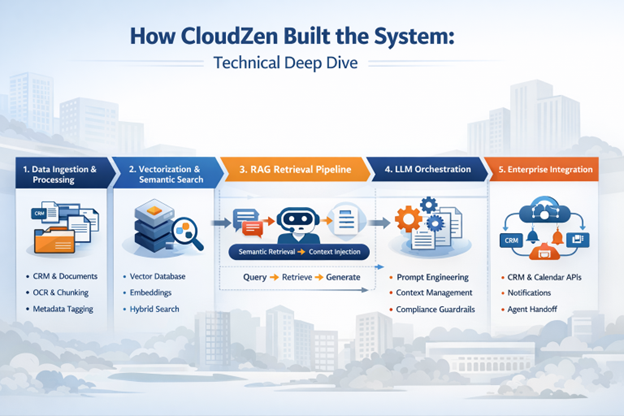
Step 1: Data Ingestion & Knowledge Engineering
- Ingested data from:
- CRM (Salesforce / Zoho)
- Property management systems
- Document repositories (PDFs, DOCs)
- Pricing sheets and inventory databases
- Applied:
- OCR for scanned documents
- Chunking strategies (semantic + token-based)
- Metadata tagging (location, property type, RERA ID, price range)
Step 2: Vectorization & Semantic Search
- Converted structured and unstructured data into embeddings
- Stored vectors in a vector database optimized for:
- Low-latency retrieval
- Hybrid search (semantic + keyword)
- Enabled filters:
- City
- Property type
- Budget range
- Availability status
Step 3: RAG Pipeline Implementation
- User query is received
- Query is embedded
- Relevant documents are retrieved from vector DB
- Retrieved context is injected into the LLM prompt
- LLM generates a grounded, compliant response
Step 4: LLM Orchestration & Prompt Engineering
- Designed:
- Domain-specific system prompts (Real Estate Expert Persona)
- Guardrails to avoid non-compliant responses
- Structured output formats (JSON for UI rendering)
- Implemented:
- Multi-turn conversation memory
- Intent classification (buy, rent, sell, support)
Step 5: Enterprise Integration
- Integrated with:
- CRM for lead creation & updates
- Calendar APIs for site visit booking
- Notification systems (SMS, WhatsApp, Email)
- Enabled human handoff to sales agents when required
3.Core Capabilities of the solution
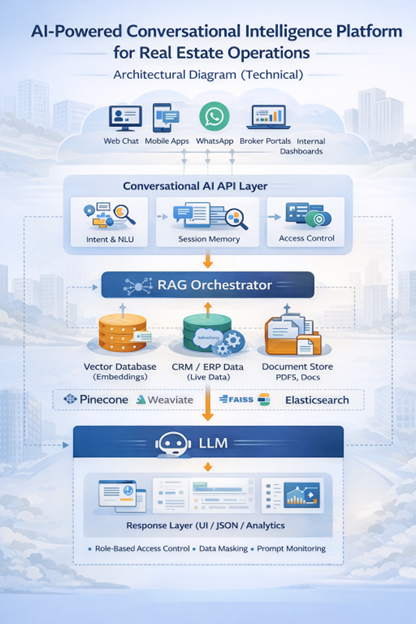
Intelligent Conversational AI
- Handles buyer, tenant, broker, and internal staff queries
- Supports:
- Property discovery
- Pricing & availability
- Site visit scheduling
- Loan & payment plan explanations
- Document-based Q&A (agreements, brochures)
Retrieval-Augmented Generation (RAG)
- Prevents hallucinations by grounding LLM responses in verified real estate data
- Retrieves information from:
- Property listings
- CRM records
- Legal & compliance documents
- Pricing catalogs
- Policy documents
Context-Aware Conversations
- Maintains session memory across:
- User preferences (budget, location, size)
- Past interactions
- Previous site visits
- Enables personalized recommendations
Multi-Channel Deployment
- Web chat
- Mobile apps
- Broker portals
- Internal sales dashboards
4. Technology Stack
AI & ML
- OpenAI GPT / Azure OpenAI / Open-source LLMs (LLaMA, Mistral)
- LangChain / LlamaIndex
- Custom prompt engineering & guardrails
Data & Search
- Vector Databases: Pinecone / Weaviate / FAISS
- PostgreSQL / MongoDB
- Elasticsearch (hybrid search)
Backend & APIs
- Python (FastAPI)
- Node.js
- REST & Webhooks
Cloud & Infrastructure
- AWS / Azure / GCP
- Docker & Kubernetes
- CI/CD pipelines
Security & Governance
- Role-based access control (RBAC)
- Data masking & encryption
- Audit logging
- Prompt & response monitoring
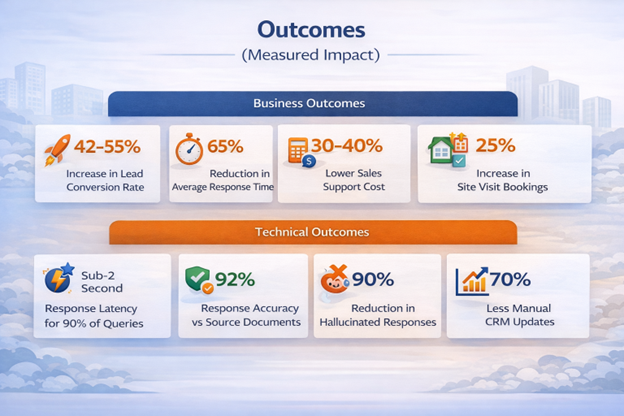
5. Outcomes (Measured Impact)